Reviewed games / 2nd President’s Cup of the Republic of Tajikistan 2026, Group A, round 9
Pranav Anand vs Aleksandr E. Usov: game review
Aleksandr E. Usov won on 16 November 2026, in the Caro-Kann Defense: Advance Variation, Botvinnik-Carls Defense. Stockfish 19 reviewed every move of both players at depth 18, double-checked the sharp moments deeper, and labelled each one from Brilliant to Blunder.
| Pranav Anand | Label | Aleksandr E. Usov |
|---|---|---|
| 0 | Brilliant | 1 |
| 1 | Great | 4 |
| 10 | Best | 14 |
| 4 | Excellent | 1 |
| 4 | Good | 2 |
| 6 | Book | 6 |
| 2 | Inaccuracy | 1 |
| 2 | Mistake | 0 |
Key moments
The Brilliant and Great moves, and the costliest mistakes, as the review explains them.
12.Bxc6: Great
12.Bxc6! The only good move here: every alternative is clearly worse.
- Takes the knight on c6.
- The next best move, 12.cxb4, would drop White's winning chances from 57% to 40% (−1.06).
- 12.Bxc6 wins a pawn and stops …bxc3.
- Takes the knight on c6 and wins a pawn once the captures settle.
- Black was threatening …bxc3, winning two pawns. Bxc6 takes care of it.
- Black answers 12…bxc6, taking back and taking b5 away from the queen, leaving White with no bishop pair.
14…Bg6: Great
14…Bg6! The only good move here: every alternative is clearly worse.
- Moves the attacked bishop to safety.
- Brings the bishop, Black's least active piece, into play (from 1 to 4 usable squares).
- The next best move, 14…Bxc5, would drop Black's winning chances from 47% to 24% (+3.18).
- 14…Bg6 gets the bishop out of the way of gxh5.
- White was threatening gxh5, winning a bishop. The bishop steps away.
- It prepares …h5: the bishop covers h5.
17…Qa8: Great
17…Qa8! The only good move here: every alternative is clearly worse.
- Protects the rook on a4, which was hanging.
- Lines up queen and rook on the a-file, so the two pieces push in the same direction.
- The next best move, 17…Ra8, would drop Black's winning chances from 46% to 35% (+1.67).
- 17…Qa8 stops Qxa4.
- White was threatening Qxa4, winning a rook. Qa8 takes care of it.
- White answers 18.O-O.
18…O-O: Great
18…O-O! The only good move here: every alternative is clearly worse.
- Castles: the king gets out of the centre and the rook joins the game.
- The next best move, 18…Bxc5, would drop Black's winning chances from 46% to 34% (+1.86).
- 18…O-O wins a pawn, picking it up with 19…Rxb4.
- Sets up a sequence and wins a pawn once the captures settle, picking it up with 19…Rxb4.
- White answers 19.Qd1.
- After 19.Qd1 Rxb4 20.axb4 Qxa1 21.Qb3 Qc3, Black comes out a pawn up (+0.33).
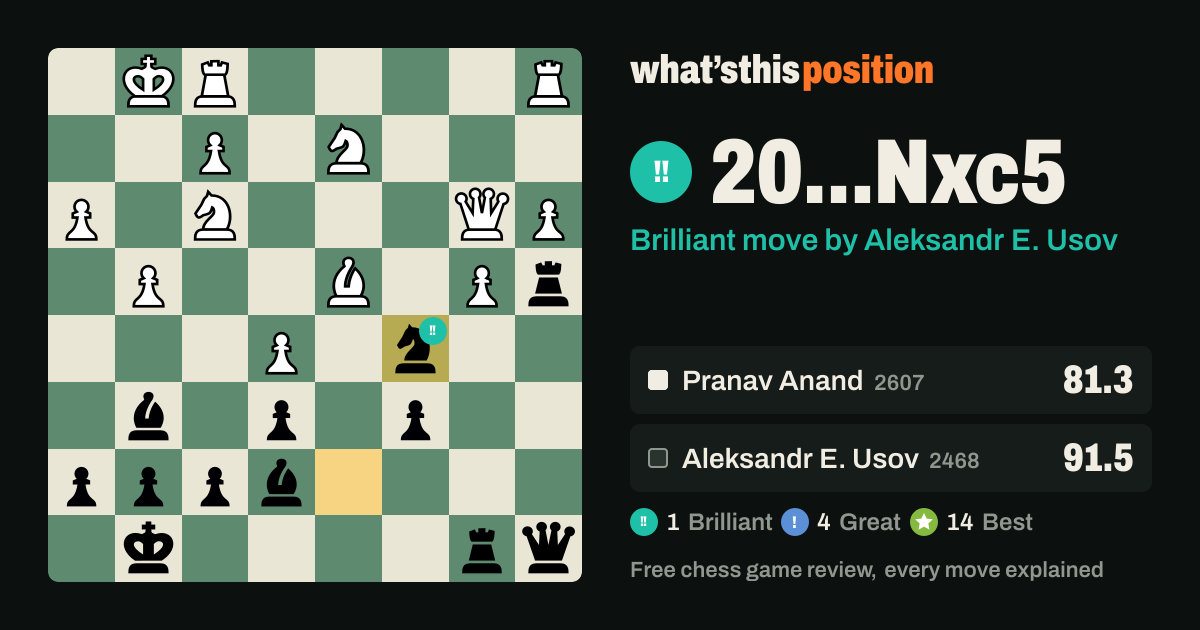
20…Nxc5: Brilliant
20…Nxc5!! A real sacrifice: Black gives up material and the engine still rates it best.
- Puts the knight on c5 where it can be taken.
- White can take, but after 21.Bxc5 Bxc5 22.Qc3 Be7 the engine rates it −0.10.
- Takes the pawn on c5.
- Shores up the e6 pawn, which was under as much attack as it had defence (1 against 1).
- 20…Nxc5 wins a pawn.
- Takes the c5 pawn and wins a pawn once the captures settle.
- The idea: 20…Nxc5!! gives up the knight on c5 to stay in the game: after it Black holds the balance (−0.10); anything else leaves Black losing (+4.12).
- What Black gives up: 20…Nxc5 puts the knight on c5 where it can be taken by the b4 pawn and the bishop on d4. That's a knight on offer.
- If White takes the knight: 21.Bxc5 is met by 21…Bxc5, taking the bishop on c5 and threatening …Bxb4, winning a pawn. Black ends up a pawn ahead: Black holds the balance (0.00). This is White's best try.
- Without the sacrifice: The best move without the sacrifice, 20…h6, is clearly weaker (+4.12 against −0.10). White answers 21.Rfc1. That would leave Black losing.
21.Qc3: Mistake
21.Qc3 is a mistake: White's winning chances go from 49% to 37%.
- Black answers 21…Nd3: moving away uncovers the bishop on e7, which now hits the b4 pawn.
- Better was 21.Bxc5 (−0.10), which takes the knight on c5.
Better: 21.Bxc5 stops …Nxb3. After 21…Bxc5 22.Qc3 Be7 23.Rfc1 h5 24.gxh5 Bxh5 25.Qxc6 Bxb4 26.Kg2 Qxc6 27.Rxc6, the queens come off (−0.10).
21…Nd3: Great
21…Nd3! The only good move here: every alternative is clearly worse.
- Moves the attacked knight to safety.
- Moving away uncovers the bishop on e7, which now hits the b4 pawn.
- The next best move, 21…Ne4, would drop Black's winning chances from 63% to 51% (−0.06).
- 21…Nd3 gets the knight out of the way of Bxc5.
- White was threatening Bxc5, winning a bishop. The knight steps away.
- White answers 22.Ne1.
26.Qb6: Mistake
26.Qb6 is a mistake: White's winning chances go from 44% to 31%.
- Black answers 26…h5: a pawn break: it challenges the g4 pawn to open lines.
- Better was 26.Rab1 (−0.67): the rook takes the open b-file.
Better: 26.Rab1 takes the open b-file. After 26…Rc8 27.Qb7 Nf4 28.Qxa8 Rcxa8 29.Rb4, the queens come off (−0.67).
The opening
Caro-Kann Defense: Advance Variation, Botvinnik-Carls Defense (B12)
- Both sides followed opening theory up to 6…Nd7: 12 moves in all, 6 by White and 6 by Black.
- Theory runs out after 6…Nd7: too few games between strong players reached this position to go further.
Every move
The moves from the official broadcast on Lichess (the game), each with its label. Step through them on the board for the engine lines and an explanation of every move.
- 1.e4c6
- 2.d4d5
- 3.e5c5
- 4.Nf3Bg4
- 5.dxc5e6
- 6.Bb5+Nd7
- 7.b4a5
- 8.c3Ne7
- 9.Nbd2Nc6
- 10.h3Bh5
- 11.Qe2axb4
- 12.Bxc6bxc6
- 13.cxb4Be7
- 14.g4Bg6
- 15.Qe3Ra4
- 16.a3d4
- 17.Qb3Qa8
- 18.O-OO-O
- 19.Bb2Rb8
- 20.Bxd4Nxc5
- 21.Qc3Nd3
- 22.Be3c5
- 23.bxc5Rc8
- 24.Qb3Bxc5
- 25.Bxc5Rxc5
- 26.Qb6h5
- 27.g5Kh7
- 28.Rfb1Rf4
- 29.Qb7Rc1+
More reviewed games
Every reviewed game, newest first.
- Erigaisi Arjun vs Wesley SoJerusalem Masters 2026, Round Robin, round 1, 23 November 20261/2-1/2Accuracy 92.9 and 93.112…Nxd4
- Ian Nepomniachtchi vs Erigaisi ArjunJerusalem Masters 2026, Round Robin, round 2, 23 November 20260-1Accuracy 87.0 and 94.921…Re8
- GZQSH07 vs MagnusCarlsenChess.com blitz, 21 November 20260-1Accuracy 85.9 and 91.59…Nxd5
- MagnusCarlsen vs GZQSH07Chess.com blitz, 21 November 20261-0Accuracy 87.1 and 85.044.Rxb4
- Talibov_Shiroghlan vs HikaruChess.com blitz, 21 November 20261-0Accuracy 91.9 and 83.310.Rd1
- Bogdan-Daniel Deac vs Parham MaghsoodlooCampeonato de España por Equipos de Club División de Honor, round 1, 20 November 20261/2-1/2Accuracy 94.1 and 95.5
See your own games like this.
Enter a Chess.com or Lichess username or paste a PGN: free, no account, no daily limit.